

The Process Was Never the Process

The Process Was Never the Process
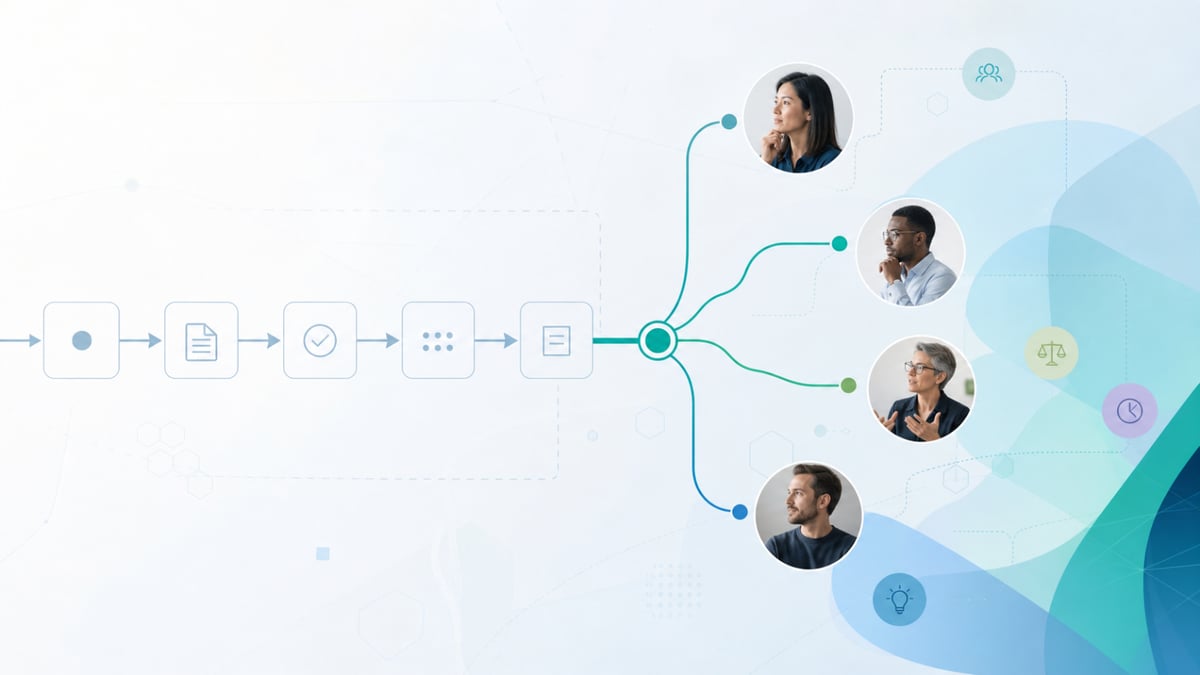
# AI Strategy

Enterprise AI is exposing a truth many organizations missed: process alone rarely creates value, judgment does.

June 12, 2026
Mark Christianson
Mark Christianson
The Process Was Never the Process
One of the more interesting side effects of enterprise AI has very little to do with AI itself. It has to do with process.
Organizations have spent decades documenting how work gets done. We have process maps, standard operating procedures, workflow diagrams, escalation paths, approval chains, and governance models. We document inputs and outputs, responsibilities and timelines. We create increasingly detailed descriptions of work in the hope that work becomes more repeatable, scalable, and predictable.
Most of the time, that works well enough because the people performing the work already understand where the documentation falls short.
An experienced employee rarely follows a process exactly as it is written. They know where the rough edges are. They know where exceptions occur. They know which rules are hard requirements and which are guidelines that have survived simply because nobody has challenged them. They understand the context surrounding the process, not just the process itself.
The interesting thing is that very little of that knowledge is usually documented.
For years, that has not been a significant problem because humans are remarkably good at filling in gaps. We hire people, train them, expose them to situations, and over time they develop judgment. Eventually they stop relying on the process and start relying on experience. The process remains useful, but it becomes a reference point rather than a script.
Then we introduce AI.
Whether it is Glean, Gemini, Copilot, ChatGPT, or some purpose-built agent, the implementation effort almost always begins in the same place. We attempt to teach the AI the process. We provide instructions, examples, guardrails, and expected outcomes. We spend hours refining prompts and tuning behavior so the system behaves consistently.
What often happens next is fascinating.
The AI follows the process.
Not approximately. Not most of the time. It follows the process exactly as we described it.
That is usually the moment when organizations discover that the documented process was never actually the thing creating value.
The value was being created by the employee who knew when the process no longer applied.
The support representative who recognized that a frustrated customer needed empathy before information. The manager who spotted a risk hidden inside an otherwise routine request. The engineer who understood that the technically correct answer would create operational problems later. The HR partner who recognized that policy compliance and the right outcome were not necessarily the same thing.
Those decisions rarely appear on process maps because they are not process activities. They are judgment activities.
This has made me wonder whether organizations are asking the wrong questions when they evaluate AI opportunities.
The common question is, What can we automate? That is a useful question, but it may not be the most important one.
A more revealing question might be, Where does judgment enter the process?
Once viewed through that lens, AI deployment becomes less about automation and more about understanding how work actually happens.
Information retrieval, summarization, content generation, classification, and routing are all areas where systems like Glean can create tremendous value. These activities benefit from consistency. They benefit from speed. They benefit from having access to more information than any single employee can reasonably hold in their head.
The challenge emerges when we move beyond execution and into decision making.
Who determines whether an exception should be granted?
Who accepts risk?
Who decides when conflicting priorities require a different path?
Who recognizes that a situation resembles previous situations on the surface but is materially different underneath?
These are not process questions. They are judgment questions.
Ironically, AI may become one of the most effective tools organizations have ever had for identifying where expertise truly resides. Every workflow that requires escalation, every output that benefits from review, and every moment where people become uncomfortable removing the human from the loop reveals something important. It highlights a place where experience, context, and judgment are contributing value that was previously hidden inside the process itself.
Viewed this way, AI is not simply an automation technology. It is a diagnostic technology.
It helps us discover which parts of work are procedural and which parts depend on human judgment.
That distinction may ultimately be more valuable than the automation itself because it forces organizations to answer a question many have never examined closely.
What exactly are our people being paid to do?
If the answer is process execution, AI will continue to absorb more of that work.
If the answer is judgment, context, prioritization, and decision making, then AI is not replacing the value. It is helping us finally see where the value was all along.
Comments (0)
Popular
avatar

Dive in

Related

Video
Admin Assistance: MCP Configuration
Jun 12th, 2026 Views 78
Video
Glean Admin Console
Apr 24th, 2026 Views 64
Resource
What actually drives Glean’s setup time, and how can teams make it smoother?
By Nikhar Gupta • Apr 24th, 2026 Views 34
Video
Admin Assistance: MCP Configuration
Jun 12th, 2026 Views 78
Video
Glean Admin Console
Apr 24th, 2026 Views 64
Resource
What actually drives Glean’s setup time, and how can teams make it smoother?
By Nikhar Gupta • Apr 24th, 2026 Views 34
© 2026 Glean Technologies, Inc.
Terms of Service
Your Privacy Choices