

Women in AI
November 3, 2026

From Experiments to Adoption: What Marvell’s AI Leader Learned Along the Way
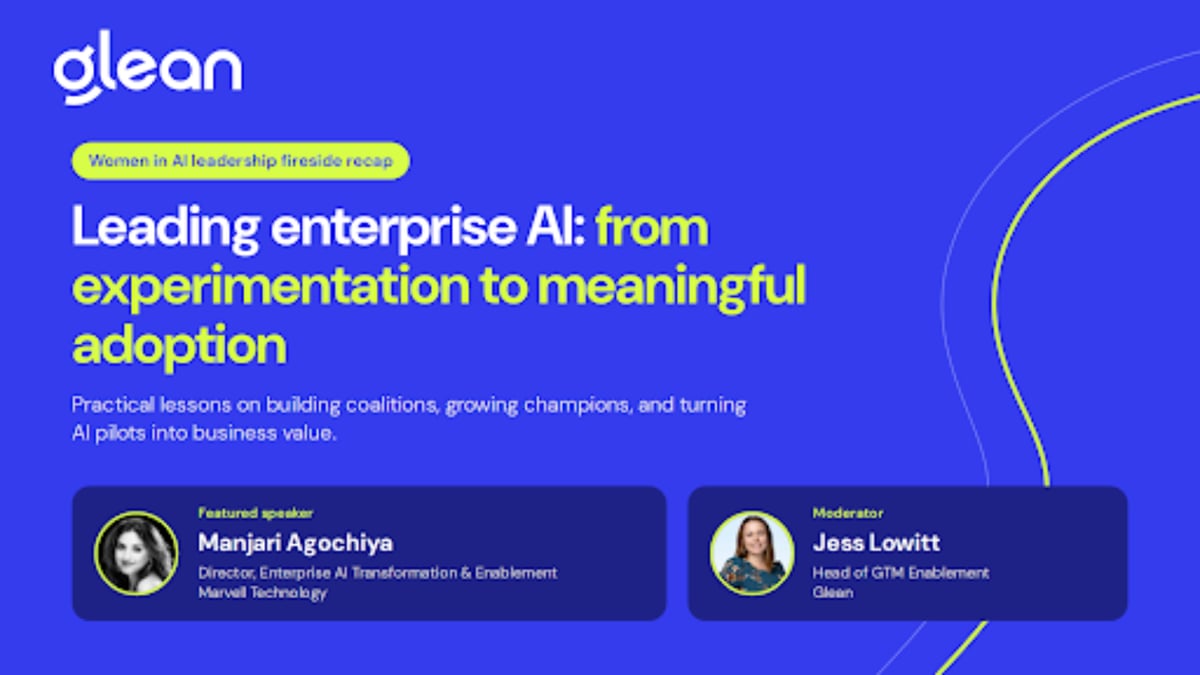
From Experiments to Adoption: What Marvell’s AI Leader Learned Along the Way
# Women in AI
# Enterprise AI
# AI Adoption
# AI Transformation
# Leadership

Four practical lessons for turning promising AI experiments into meaningful adoption.

Honey Pamnani
Honey Pamnani
From Experiments to Adoption: What Marvell’s AI Leader Learned Along the Way
Women accounted for just 26% of U.S. hires into AI roles in 2025, according to  LinkedIn Economic Graph research, reported by the World Economic Forum . As AI reshapes how we work, build, and lead, that gap matters.
That’s why we launched Women in AI, powered by Glean: to give women more opportunities to learn from one another, connect with leaders, and take part in the conversations shaping enterprise AI. Women and allies are welcome.
Our first Women in AI Leadership Fireside, on October 23, featured someone who embodies what the series is about. When Manjari Agochiya began leading generative AI transformation at Uber in 2023, she had no AI title and no playbook. Within a year, a cross-functional team of about 10 people had completed 168 AI intake reviews for a company of 52,000.
Today, as Director of Enterprise AI Transformation & Enablement at Marvell Technology, she’s doing it again. She sat down with Glean’s Jess Lowitt, Head of GTM Enablement, to share what it really takes to move from experimentation to meaningful adoption. Here are four lessons from the conversation.

1. Build the coalition. Don’t wait for the title.

“I did not have a title in AI at that time,” Manjari recalled. What she had was clarity on what the company needed. She brought security, legal, compliance, sourcing, business leaders, and the AI platform owner into a small working group. Each function dedicated two or three people to AI decisions. That strike team let Uber run AI centrally, with full leadership visibility and a shared budget.
Try this: List the 4–5 functions whose “yes” your AI initiative depends on, and invite one person from each into a standing working group.

2. Grow adoption through champions, not mandates.

When leadership is all in but day-to-day users are stuck, Manjari starts with the people who are already excited. Their enthusiasm spreads in ways an announcement can’t, because colleagues “will listen to somebody they trust.” For influential skeptics, she makes time for one-on-one learning, since a public forum can feel intimidating.
Try this: Find three curious colleagues, help each get one real win, and ask them to share it with their team.

3. Ground your voice in evidence.

Manjari described being the only woman in a meeting with senior leaders, where she raised a forward-looking risk: soon, every SaaS product in the company would be AI-enabled. The others began repeating her point to one another as if she weren’t in the room. Her answer has been to be the best-prepared person there, with every fact checked. “They can ignore you twice, but they cannot ignore you 10 times.
Try this: Before your next high-stakes meeting, prepare the three data points that make your case hard to dismiss. And when you see someone’s idea get talked over, credit it back to them.

4. Measure what changes, not just what gets built.

With everyone building and vibe coding, Manjari expects most early AI work to be experimental, and she says that’s okay. The job is to steer it toward value. In business-domain workshops, she asks teams what their tool actually changes in the workflow. With limited bandwidth, she focuses on the highest-impact domains or wherever token consumption is highest. At Marvell, that data led her to shift support toward engineering. She also keeps evaluations moving: at Uber, her team cut POC approvals from four to six months to two weeks. Her reminder for anyone pitching AI to leadership: “ROI is still ROI.”
Try this: For every AI experiment, write one sentence on which workflow it improves and how you’ll measure it.

One step for the next 30 days

Asked for one concrete action, Manjari turned the question inward: define what success means to you. “Measure yourself against who you were and where you want to be.”
Thank you to Manjari, Jess, and everyone who joined and contributed to the conversation.
Up next: Demystifying AI with Harshi Murthy, Product Manager at Glean, on Friday, November 20 at 9:30 AM PT / 12:30 PM ET. [ Register → ]


Comments (0)
Popular
avatar

Dive in

Related

Resource
What does a realistic “from contract to first value” timeline look like for Glean
By Nikhar Gupta • Apr 24th, 2026 • Views 259
Blog
The Process Was Never the Process
By Mark Christianson • Jun 12th, 2026 • Views 142
Blog
Turning a first-draft AI artifact into content that actually resonates
By Mark Christianson • Jul 7th, 2026 • Views 362
Resource
From Source Material to Usable Output with Glean
By Mark Christianson • Jun 30th, 2026 • Views 249
Resource
What does a realistic “from contract to first value” timeline look like for Glean
By Nikhar Gupta • Apr 24th, 2026 • Views 259
Blog
Turning a first-draft AI artifact into content that actually resonates
By Mark Christianson • Jul 7th, 2026 • Views 362
Resource
From Source Material to Usable Output with Glean
By Mark Christianson • Jun 30th, 2026 • Views 249
Blog
The Process Was Never the Process
By Mark Christianson • Jun 12th, 2026 • Views 142